
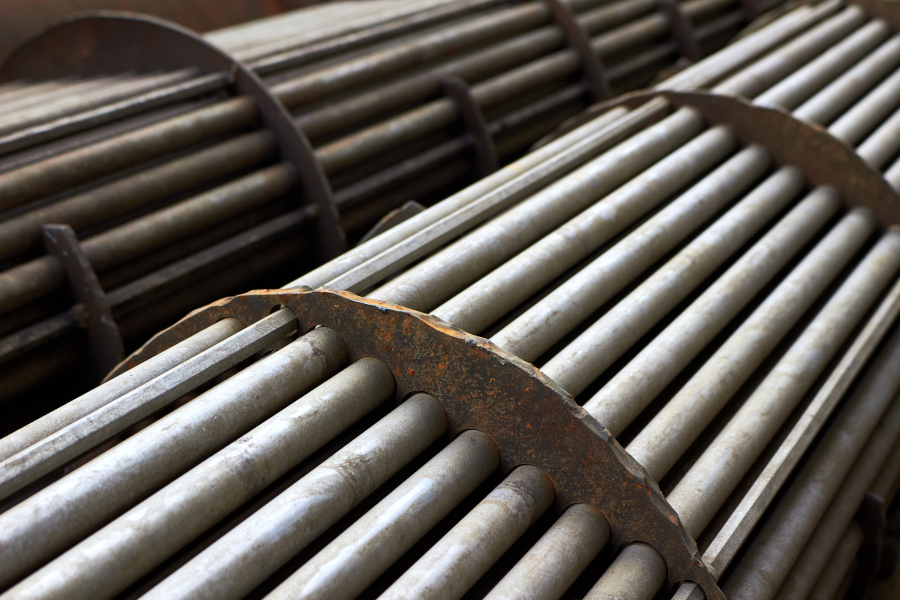
As with other aspects of heat exchanger design, the choice of construction material depends on a number of factors based on the end use. These include general considerations, such as thermal efficiency, cost and durability, and others which may be more specific to a particular situation, such as hygiene, cleanability, and corrosion resistance. In many cases construction material selection may relate to finding the best compromise, as the material with the best heat transfer may not be the most hygienic or easy to clean.
In the simplest terms, copper and copper/nickel alloys are likely to have the greatest thermal conductivity, while composite materials and ceramics have the lowest; much can be achieved with good heat exchanger design. This means that in practice, materials with slightly less thermal efficiency, such as carbon and stainless steel, will provide exceptionally good heat transfer in practice. This is why most heat exchanger manufacturers use some form of steel for the majority of their products.
However, there are a number of advantages to choosing stainless steel over carbon steel, including using 316L stainless steel for the corrugated tubes in heat exchangers and 304L stainless steel for the outer shell.